

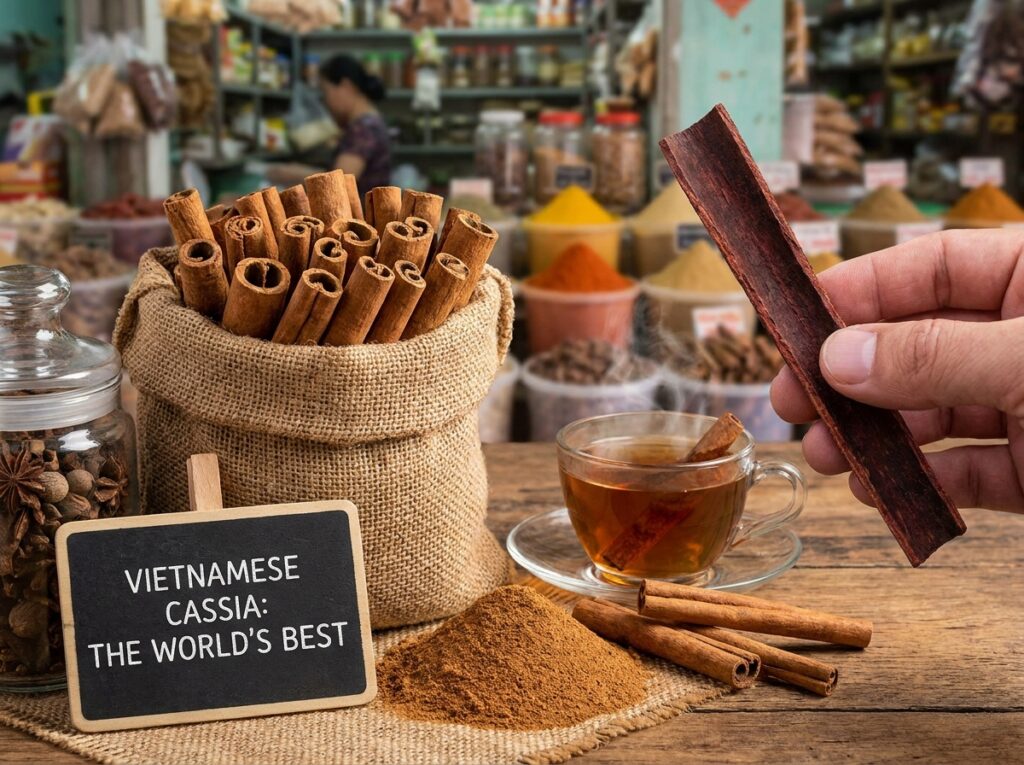
Most people assume all cinnamon is the same — but its origin, variety and processing tell a very different story. As a farmer from Xuan Ai Commune in Lao Cai, surrounded by what we call cay vang xanh (the “green gold tree”), let me help you cut through the confusion and choose the best cinnamon for your kitchen.
Is All Cinnamon Created Equal?
No. Four main types compete for the title of “best” — Cassia, Ceylon, Saigon and Korintje — and they differ sharply in flavour, aroma and oil content. Here in Xuan Ai our Vietnamese Cassia stands out for its uniquely high oil content, reaching up to 5% at peak quality. That gives it an intense, spicy warmth that milder cinnamons simply can’t match.
The 4 Main Types of Cinnamon Compared
| Type | Flavour & aroma | Oil content | Best for |
|---|---|---|---|
| Vietnamese Cassia (Saigon) | Bold, spicy, intensely warm | 3–5% (highest) | Coffee, stews, robust baking, mulled drinks |
| Ceylon (“true cinnamon”) | Mild, sweet, delicate | 1–2% | Delicate desserts, light baking |
| Korintje (Indonesian cassia) | Sweet, smooth, moderate | 2–4% | Everyday baking, mass-market blends |
| Chinese Cassia | Strong but often less refined | 1–2.5% | General cooking, commodity supply |
Note: “Saigon cinnamon” is a variety of cassia — it is not a separate species from Vietnamese cassia. Ours is grown in the northern highlands, not the south.
✅ Truth
Variety and growing conditions decide quality. High-altitude soil and a cool climate produce superior oil content, especially when bark is harvested at peak (years 15–25).
❌ Myth
“All cinnamon is the same.” Settling for the cheapest option means missing the aroma and depth that origin and oil content deliver.
What Makes the Best Cinnamon?
Three things decide it:
- Oil content — the heart of flavour. Our cinnamon peaks at 3–5% oil between years 15 and 25, giving a richer, more intense taste.
- Origin — the Dao people first planted cinnamon in Northwest Vietnam nearly 200 years ago. Xuan Ai’s cool mountain climate and rich soil, across over 6,000 hectares of forest (2,000 certified organic), create the ideal cradle.
- Harvest and drying — we harvest in autumn (August–September) when oil content is highest, then sun-dry the bark on bamboo racks for several days to lock in the aroma.
Quick Facts
- Peak quality: trees aged 15–25 years, 3–5% oil content.
- Best harvest window: autumn (August–September).
- 6,000+ hectares of cinnamon forest in Xuan Ai; 2,000 hectares certified organic.
Which Cinnamon Should You Choose?
If you want the boldest, most aromatic option with real heritage behind it, Vietnamese Cassia is hard to beat. If you prefer a mild, sweet spice for delicate baking, Ceylon may suit you better. The point isn’t that one is universally “best” — it’s that knowing variety, oil content and origin lets you choose the right cinnamon with confidence instead of grabbing whatever’s on the shelf. New to it? Start with our guide to what Vietnamese cinnamon is, or compare formats in our powder guide.
Our Promise
The love and care we give our trees — from planting through to a patient 15-year wait for peak bark — is what separates truly great cinnamon from the ordinary. When you choose ours, you’re choosing nearly two centuries of tradition, harvested by hand and shipped direct with no middlemen.
Ready to taste the difference? Explore our Vietnamese Cassia Sticks (Whole Quills) or our Cassia Powder — hand-harvested and shipped direct from our family farm in Lao Cai. Learn more about our story.