

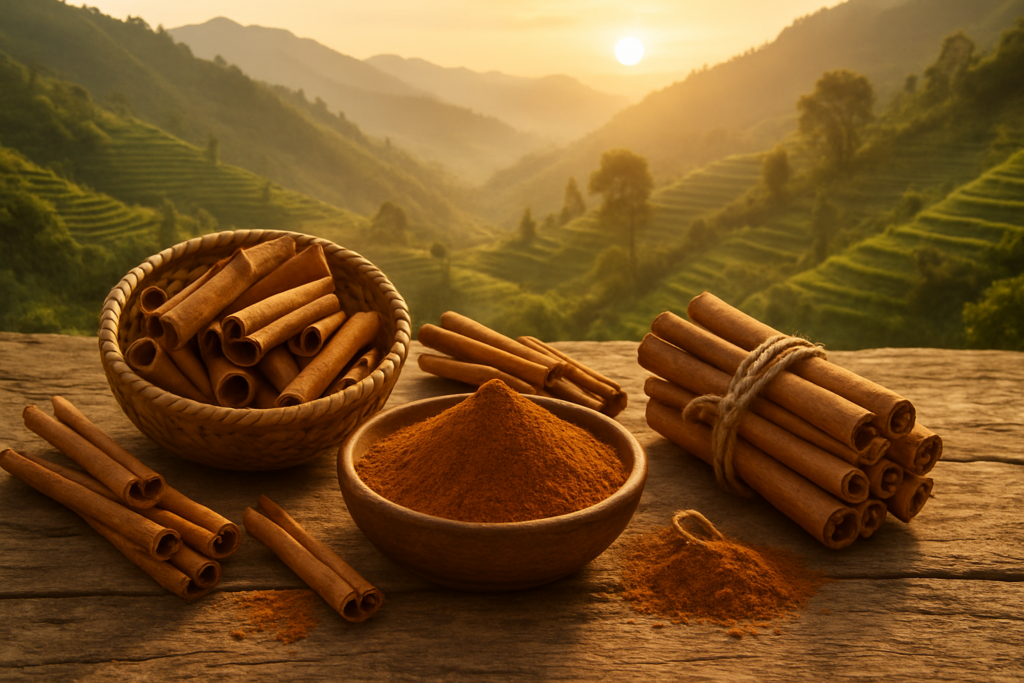
Did you know that Vietnamese cinnamon powder is often mistaken for its cousin, Ceylon cinnamon? It’s a common mix-up. Yet, our cinnamon from Xuan Ai Commune, with its robust flavor and aroma, stands in a class of its own. Being a farmer from the birthplace of cinnamon farming in Vietnam, I have the privilege of sharing with you the profound journey of how our cinnamon transforms into the aromatic powder cherished worldwide.
Why Xuan Ai’s Cinnamon Stands Out
Xuan Ai, a small corner of Northwest Vietnam, isn’t just any village. It’s the birthplace of Vietnamese cinnamon, with nearly 200 years of history behind it. We cultivate over 6,000 hectares of cinnamon forest, out of which 2,000 hectares are certified organic. The Dao ethnic people were the first to plant these trees, and today, we continue their legacy. This place, with its altitude of 200-1000 meters and rich mountain soil, provides the perfect conditions for growing exceptional cinnamon. And here’s a fun fact: locals affectionately call it ‘cay vang xanh’ or ‘green gold tree’—a testament to its value.
What’s in a Name? Vietnamese Cinnamon Powder Explained
Many wonder what makes Vietnamese cinnamon powder so distinct. Well, it all starts with our careful cultivation process. From planting to nurturing, the first five years are crucial. We then harvest the leaves from the third to the fifth year for essential oil. Our cinnamon trees reach their peak quality between 15 to 25 years, yielding a bark with an oil content of 3-5%. And this is precisely when the bark is harvested, dried, and ground into the fine powder we all love. For more about our cultivation story, visit our story.
How We Make Vietnamese Cinnamon Powder
The transformation from tree to powder is an art. First, we peel the bark using a curved knife during the harvest seasons—autumn (between August and September) offers higher oil content, while spring (February to March) delivers a milder aroma. After harvesting, the bark is sun-dried for 3 to 7 days on bamboo racks, a traditional method we’ve perfected over generations. Once dried, the bark is meticulously ground into the flavorful Vietnamese cinnamon powder you can find in our Vietnamese Cassia Powder.
Comparing Vietnamese Cinnamon Powder: Quality by the Numbers
Let’s talk specifics. Why is our cinnamon powder sought after? Here’s what sets it apart: Vietnamese cinnamon has a stronger, spicier flavor compared to Ceylon cinnamon. It contains a higher oil content, between 3-5%, whereas others may fall below 2%. In terms of eugenol, a compound responsible for its distinct aroma, our cinnamon ranks top. The result? A powder that’s bold and aromatic, ideal for both culinary and medicinal uses.
Quick Facts
- Xuan Ai has 6,000+ hectares of cinnamon forests.
- 2,000 hectares are certified organic.
- Cinnamon trees peak at 15-25 years with 3-5% oil content.
- Autumn harvest yields higher oil levels.
- Known locally as ‘green gold tree’.
Practical Takeaways for You
When you choose Vietnamese cinnamon powder, you’re not just adding spice to your dish; you’re embracing a piece of our culture. Remember, every spoonful contains years of tradition and dedication. Whether you’re baking, brewing, or exploring its health benefits, this powder is your go-to. It’s not just a flavor; it’s a piece of my world, shared directly with you, ensuring fair prices for our farmers and the continued growth of our beloved ‘cay hanh phuc’, or ‘happiness tree’.