

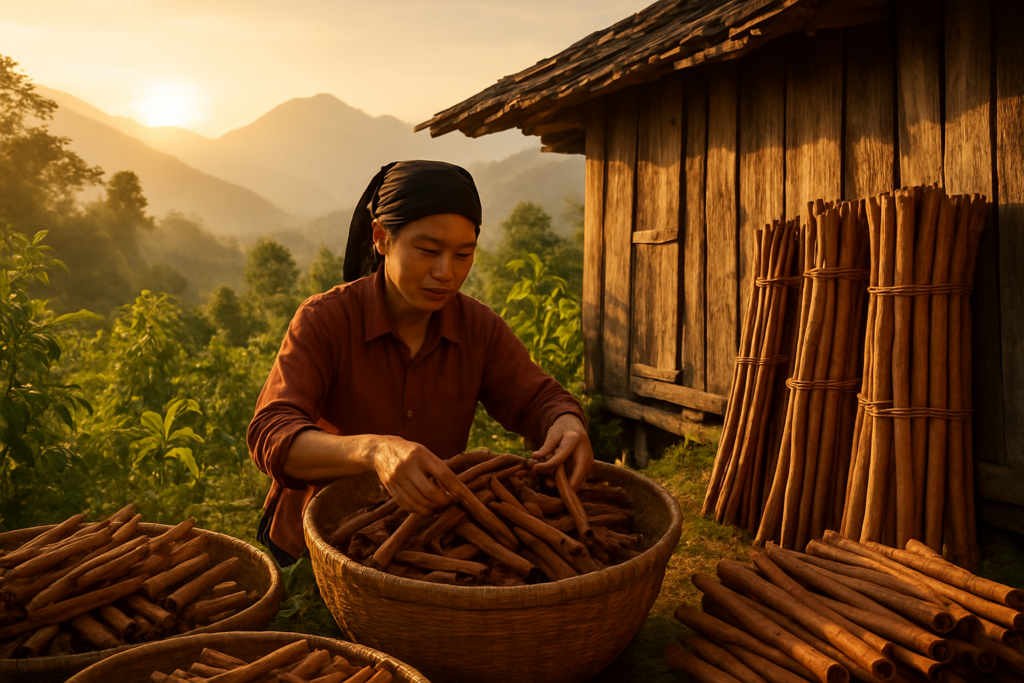
Most people think cinnamon is harvested like any ordinary crop, but actually, it’s quite a sophisticated process. Our cinnamon harvest season in Xuan Ai is steeped in tradition and precision, where every step counts in maintaining the quality of what you ultimately enjoy in your kitchen. Now, let’s clear the air on some common misconceptions and unveil the truths behind this deliciously aromatic season.
What Time is the Right Time? Harvest Seasons Compared
Many believe that there’s a single ideal time to harvest cinnamon—just like one might think of harvesting rice or corn. However, our experience shows this isn’t the case.
✅ Truth
In Xuan Ai, we actually have two distinct harvest seasons for cinnamon: spring (February-March) and autumn (August-September). The cooler climate and diverse mountain altitudes, ranging from 200 to 1000 meters, allow our trees to thrive in both these seasons. Each one influences the oil content and flavor differently. Autumn, with its higher oil content, provides a more robust and spicy profile.
❌ Myth
There’s a common myth that cinnamon is only harvested once a year for maximum yield and quality. Folks think this is true, but what’s real is how the distinct climates of the two seasons enrich the bark, offering varied flavor profiles that cater to different culinary needs.
Myth: Cinnamon Trees are Harvested Annually
Cinnamon isn’t some annual affair. I remember, as a kid, watching my family nurture the trees for years before any major harvest. You may be surprised to learn that it takes a minimum of eight to ten years before the bark is even ready for harvest. And it’s between 15 to 25 years that it reaches peak quality, with the highest oil content.
This nurturing period is what gives our Vietnamese Cassia Sticks (Whole Quills) their renowned rich aroma and flavor. It’s not merely a waiting game; it’s a testament to patience and expertise.
How is the Cinnamon Bark Harvested?
Some folks think we just chop off whatever part looks good (I wish it were that simple!). Instead, the process involves skill and care. First, we use a curved knife to peel the bark carefully—never wasting a bit. Once harvested, the bark is sun-dried for three to seven days on bamboo racks. This is not just about drying; it’s about letting the natural essence concentrate while the cinnamon basks in the sun.
5 Numbers Behind the Harvest
When we talk numbers, we’re not just throwing figures around. Let me lay it down: over 6,000 hectares of cinnamon forest in our region, with 2,000 hectares certified organic. Our trees are nurtured from year one to five, with leaves harvested for essential oil between years three to five. Bark is harvest-ready in eight to ten years, peaks at 15 to 25 years, while oil content ranges between 3-5%.
It’s a timeline of dedication—something the Dao ethnic people, the pioneers of Vietnamese cinnamon farming, understood deeply. Every year, every cycle, imbues the material with a story and quality that’s hard to beat. Our commitment ensures that no part of the tree goes unused: trunk bark for sticks, branch bark split for different uses, and the leaves distilled into oil.
Why Our Cinnamon Trees are Called ‘Cay Vang Xanh’ (Green Gold Tree)?
Because they truly are like gold to us. The term ‘cay vang xanh’ might sound poetic, but ask any farmer here and you’ll see it’s a title earned through hard work and respect for nature. The cool climate and rich soil of our mountain range are gifts, yes, but also responsibilities we hold dear. Our practice of selling directly, with no middlemen, ensures we maintain a fair price for all of us engaged in the art of cinnamon farming. If you want to dive deeper into these traditions, check out our story.
The cinnamon harvest season in Xuan Ai is a time of rhythm and life, a celebration of years of nurturing, patience, and hands-on labor. Unwrapping these myths shows the truth about what it takes to bring high-quality cinnamon from our forests to your table. Every piece of bark tells the tale of its journey from ‘cay hanh phuc’—the happiness tree. We know it enriches our lives, and I hope it does the same in yours.